

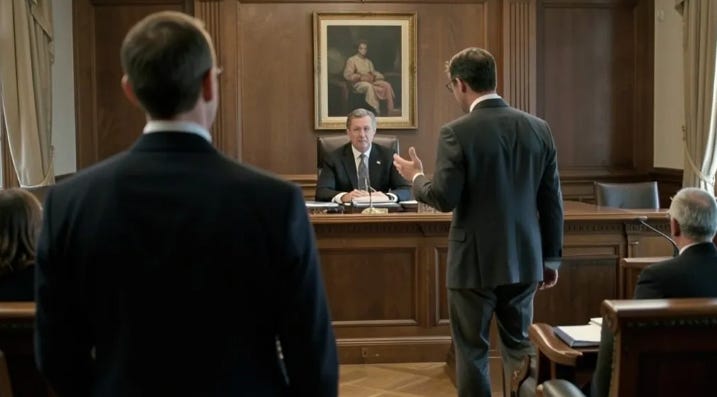
If he was to describe the mindset beneath the machinery, he would say his is not nearly as simple as a ‘criminal’ mindset. Mind you, it is a hierarchal mindset. His first loyalty is not to the realm of truth or justice. His first loyalty is to position. Status. Control. His placement within the pyramid is what matters. He ranks high. It’s where he fits.
That doesn’t mean he thinks about it every day. In fact, he doesn’t. It’s deeper. It was archetypical when he learned very early that vulnerability was unacceptable along with dependence, weakness, being beneath someone.
Most people learn reciprocal obligations with the catch-all-words like empathy, trust, accountability, love, guilt, shame and remorse. Not him. The acknowledgment that other people occupy space as fully as they do never completed the journey in his head. Or perhaps, more accurately, he arrived at his destination differently.
He took all that energy and converted it into superiority. When another child said, “I feel small,” he eventually said, “Then I shall never be small again.” When another child said: “I am frightened,” he heard it. He eventually said, “Then I shall become the frightening thing.” When a child said, “I am vulnerable,” he eventually said, “Then I shall never reveal vulnerability.”
He also learned early that witnesses to his self-declarations became extraordinarily important. Because witnesses threatened his place. Witnesses reduce his altitude. Witnesses drag things downward. All the way down to complicity, accountability, scrutiny, and, gods forbid it, equality.
That is as close as he gets to hate because it’s nothing personal. It’s positional. A witness represents deviation in disinformation. It’s better to stick to rumour becoming a fact, safer by and large, which produces a shrinkage of person. A truth must be excoriated to maintain essential distance above the crowd.
To be clear, he does not believe he is avoiding responsibility by eschewing accountability. He came to believe accountability was for other people. He knows himself to be exceptional. The rules aren’t insulting because they exist. The rules are insulting because one might presume they apply to him. They do not, ever -- absolutely never do they -- apply to him. This was an adamant rule.
In climbing the ladder he never displayed hate or fear, in the deployment of witness management. He engaged it in secret pride. He was proud of subverting justice, burying those pesky intruders. That’s what makes him dangerous. Because if witness suppression, interception, discrediting, containment, exhaustion, isolation, and disappearance are merely tactics, then he is nothing but a criminal.
But if these skills are honed into craft, discipline, accomplishment, then they become his identity’s markers of success. It makes him darker. It makes him impossible to spot. In this professionalism he has this lack of remorse, because the witness:
remains the troublesome component.
arrives carrying independent observation.
insists on unsolicited shared reality.
delivers a portent of competing versions of events.
presents a stubborn fact of refusing to abide by a narrative.
And therein lay the challenge. Being assiduous as well as professional, he understood something amateurs never did. The amateur says:
I hope nobody saw.
Well. Hope was not a strategy. Hope was wishful thinking disguised as nothing.
The assiduous man says:
Somebody probably did. That assumption becomes foundational -- a first principle. In his world view, reality produces witnesses the way atmosphere produces storms. The question is never whether they exist. The question is always what to do about them, even how to survive them.
Over time he became exceptionally skilled at answering that question. It was not merely a habit. The skill was more than adornment. A point of pride, indeed. But frankly one more competency in an expanding collection of competencies. Some people became known for leadership. Others for intelligence. Others for negotiation.
He quietly admired his own ability to identify emerging ‘problems’ and stop them before they matured into destructive contributions to an appropriately contrived narrative.
This means identifying witnesses before they mature into evidence. And identify evidence before it matured into accountability.
It was a sophisticated chain of understanding. In his opinion, one deserving of respect. The world praised architects. Engineers. Strategists. Administrators.
Never lawyers.
Only an important few appreciated the effort required to keep inconvenient realities from gaining momentum. He did. He appreciated it every day. It made him rich. Witnesses were never merely people. Witnesses were unfinished business. Loose ends. They were administrative complications. Variables requiring attention. His life’s work had been devoted to reducing those particular variables.
Intercepting them.
Managing them.
Suppressing them.
Outlasting them.
Occasionally rendering them irrelevant.
He considered this the practical work of a pragmatic individual. Others might call it perverting justice. He would regard that as an emotional interpretation, if anyone dared to bring it up. Justice was simply another system to be influenced:
delayed,
redirected,
managed,
perverted.
Problematically, the witness is the one variable he can never entirely audit, because they are:
The one recurring discrepancy in an otherwise disciplined ledger.
The one imperfection in a structure he greatly admired.
Sometimes he thought about witnesses more than he thought about success itself. That realization irritated him. Success should occupy his mind. Not middling resistance. Yet resistance persisted because a witness remembered, and sometimes lingered. A witness occasionally refused to yield. Those were the memorable ones. Those were the professional adversary’s witnesses because they possessed the one quality he could neither purchase nor manufacture and above all suppress.
Persistence.
Not that they were extraordinary people. It was because they remained stationary when pressure suggested movement. Like rocks refusing to roll downhill.
This is the final reckoning. To make it perfectly clear, witnesses don’t frighten him. Witnesses vex him. Witnesses do not obstruct him. Managing witnesses has become one of the accomplishments by which privately he measures his own worth.
It is a wonderfully bleak outcome for those people when he succeeds (which is always) because it means the witness isn’t merely his antagonist. They are also his target. The witness helps refine his skills.
Enter the witness. These people challenge that arrangement when they present gravity. They are reality. They’re the universe whispering to him, “ You belong down with everyone else.”
And he is repulsed by them for this reason.
Not because they are brave. Not because they are righteous. Not because they are moral.
Because they are leveling the playing field. Witnesses flatten hierarchy. They transform giants into defendants. Executives into suspects. Predators into subjects. Legends into facts.
And somewhere inside, he understands this perfectly. Which is why he cannot stop looking for them. (After a third or fourth Courvoisier, he will admit it’s also why Witness Protection exists.)
A witness is the one person in his story who refuses to recognize his self-attained rank. That’s a profound insult in his universe. And that insult may be far more painful to him than any punishment could ever be. He doesn’t intend to find out, which is why witnesses disappear. He has never lost a minute of sleep over what he had done to anyone. He may have lost a decade over who might have seen him do it.
In his head, he’s not doing anything wrong. But if he thinks he is exposed, he becomes the kind of man who becomes what others consider scary. That’s him.
People in hierarchies disregard others who dwell under entirely different conditions. In fact, part of his identity has been built around the absence of remorse, which he sees as strength. Discipline. Clarity. Professional distinction.
His contempt is reserved. Not for what happened. For the witness to what happened. It is the witness who is irrational. The witness becomes the flaw in an otherwise perfect equation. The witness becomes the dust on a mantel. People can almost hear him thinking:
Remorse is for people seeking forgiveness. He will have none of it.
If he is spreading disinformation about people, it’s because there’s one thing he despises, and that is witnesses, simply because they existed.
His world is wonderfully cold. If it’s hatred it is bereft of passion. It is hatred born of inconvenience. A witness possesses agency. A witness produces discomfiting clarity. A witness is something to be managed out of existence because introducing uncertainty is an insult. He never goes there, but if he sought a deeper revelation, which he will delay until his dying breath, his hate grows from his respect for them. He would never admit this, not even consciously.
But every page of an vanishing indictment proves it. Why else would he spend years thinking about them? Why else would he scan rooms? Watch doors? Review conversations? Audit aged-out events? Occasionally he realizes the witness occupies far more space in his mind than he occupies in theirs. When this happens it is almost catastrophic.
What if the witness barely remembers the crime? That’s insulting, especially since he thinks about the witness and their existence every day. That’s where the taste of dust comes from. That’s where the bitterness comes from. That’s where he feels the blowback.
Perhaps this is the archetype: His first lesson in crime was to be on the lookout. The last lesson was realizing the most dangerous witnesses never leave the scene. Some became statements. Some became evidence. Some became convictions. Most, however, could be made into nothing at all. So he watched for them and watched over them year after year. Like a man in tornado alley. He knows it isn’t remorse. He believes it to be the only form of imprisonment he will ever face, since all the witnesses have disappeared.
And the ugly irony is that the witness never actually has to do anything. Their existence serves as the reminder of the reason for his sentence inside the prison of his own head. One glance at a time, each haunting observation by a man who cannot stop auditing reality after the fact. Just for consequence. Not for guilt. Only to spot the witness.
And who are these witnesses? Why do they seek protection? For good reason, that’s what he knows. The ones who looked into an infraction too long. The ones who paused. The ones who seemed to recognize something. The ones who can and will identify a perpetrator. Most of them recognized nothing. He knew this. Yet his gaze lingers on them anyway out of habit. An occupational injury of the soul.
He will sit in restaurants with his back against the wall. Not because he is threatened. Because he prefers knowing who entered. A harmless preference. A pragmatic preference. At least that was what he tells himself. People explain themselves constantly. Few are aware of it. An ordinary person enters a room and sees furniture. He enters a room and sees possibilities for crippling betrayal.
Witnesses. Potential witnesses. Previous witnesses. Impending witnesses. Hidden witnesses. People who might someday become witnesses. If he’s going to be haunted there’s more than a few ghosts there.
The distinction is important. It never leaves him to want to stop them.
Even if years scatter fragments across the landscape, someone remembers a conversation. Someone remembers a vehicle. Someone remembers a date. Someone remembers where they had been standing when something peculiar to a witness happens.
People seem incapable of forgetting the correct detail. They forget everything else. But never the one detail capable of causing disruption. This irritates him, even though he occasionally admired it. Above all, most of all, he fears it. The witness occupied a peculiar place in his imagination.
They never appear as heroes. Heroes belonged in books and he doesn’t read trash. Witnesses are ordinary. They don’t have height. Or weight. Or allure. They have a problem. Him. But it is extraordinary for some people to move unpredictably.
Heroes followed stories. Witnesses followed life. Life wanders too close to and learns to run away from calamity. One day the witnesses are silent. Another day they are verbose. Another day they had nothing left to lose.
All three versions of the same person possessed different levels of spine. This uncertainty works for him. A drip. A leak. A slow intrusion of water running hard over a stone. Nothing dramatic. Nothing visible. Yet over years entire mountains changed shape. He sometimes wondered whether anyone noticed the ‘tell.’
You cannot see the fear, but you can see the posture. Certain people are prone to endless scanning. They cannot stop looking. They have small hesitations. Imperceptible calculations. They might even ask a question at precisely the wrong moment. They may say something to a journalist, in an article appearing in a newspaper or on a broadcast. They might disclose a secret after a knock at somebody else’s door. They might make an unexpected telephone call to 911.
They might have a chance encounter in a parking lot and escape. Each event produced the same response. The old assessment returns. Who knows? Who talked? Who saw?
The questions appear instantly. He could never stop them. He could only wait for them, and create the diversions to make them pass, divert them to extinction on his best days. The cruel truth, he had come to realize, was that the witness need not speak at all.
The silence proved sufficient to raise his hackles about what they knew. The possibility of speech did most of the work. That was the true prison. It wasn’t penal code punishment. It was the ever-present possibility of the story being told, truthfully.
A witness sitting quietly somewhere in the world could exert pressure simply by existing. Some of them without intending to, without ever wanting to know what they saw, occupied permanent residence in the architecture of his mind.
All these years later he no longer expected discovery as much as he embraced uncertainty. Discovery had shape. Discovery had rules. Discovery eventually ended in his ultimate demise. Equally, the uncertainty reproduced itself indefinitely. Like mould in darkness. Like roots beneath a foundation. Like a voice behind a wall. There. Barely there, imperceptibly there. Never to be heard if he had his way.
An event is temporary. The witness is forever because it carries the one thing impossible to recover once it escaped containment. Reality. Not evidence. Not allegations. Not rumours. Confirmation of conviction, an altered reality. Disinformation to his world view.
He looks out the window. A stranger crosses the street beneath a fading afternoon and cloudy autumn sky. Nothing unusual. Nothing remarkable. The stranger never even glanced his way. Yet his eyes followed the figure until it disappears around the corner. Only then does he exhale.
The movement was unconscious. He barely noticed it. Somewhere, perhaps, a witness still exists that he has to deal with.
Perhaps not. It no longer mattered. The possibility had been enough his whole life long. Without doubt that possibility had been walking beside him for years. Invisible. Silent. Faithful to its mission.
Like a shadow that refused to fall behind.
McColl Magazine Public Safety: Witness
