
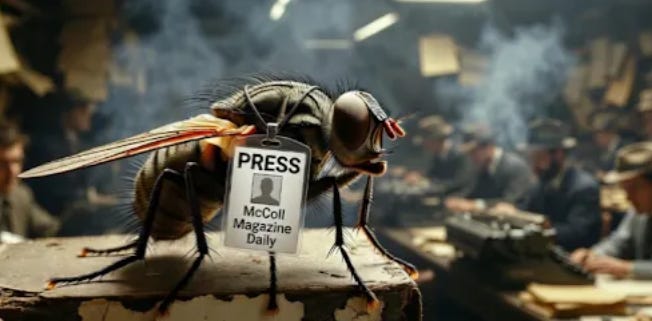
Fly-on-the-wall black satire. Moribund Desk. Where the Independent Journalist can be heard muttering “the shit I’ve seen,” more than a few times each night (with one fly on the wall come to perch on the rim of a chipped tea-stained mug, watching and listening, waiting. Always waiting fir the story.)
The Independent Journalist slumps into the Moribund Desk chair, a rickety old wood thing with a crushed pad on the seat — the desk reserved for topics too tired to be tragic and too tragic to be tired — where he is often heard to mutter, “The shit would blow your mind.”
The Fly stands on the rim of the stained mug, all six feet planted like he’s clocking in for a shift. He doesn’t speak. He never does. He just listens, because the Fly on the Wall knows that when a Independent Journalist starts a sentence like that, something feral is about to crawl out of his mouth, something the fly on the wall is waiting for.
The Independent Journalist rubs his face. “Let’s talk posture. I’ve been watching Netflix. The reality streams.”
The Fly on the Wall leans in. “I’ve discovered the posture of the Stress Bandit,” the Independent Journalist begins. “There’s a posture that keeps showing up in violent‑incident and trauma footage — the kind of posture that makes you wonder if the human skeleton was designed by a committee that never met in person. Head thrust forward. Neck compressed. Chin jutting like it’s trying to escape the rest of the face. Shoulders rounded in a way that suggests the person is trying to fold themselves back into the primordial soup.”
The Fly on the Wall has seen it a thousand times.
He’s seen it on humans, raccoons, politicians, and once on a man who dropped his ice cream cone on a sidewalk in a hot day in July. People call it a “violent‑offender posture,” as if the nervous system has a special setting called Felony Mode.
The Independent Journalist snorts. “It isn’t.” The Fly on the Wall nods — or maybe he just adjusts his wings. Hard to know why a fly on the wall is so prescient.
“The universe collapses in a signal posture. The disappearing neck is a universal stress reaction that defines the disappearance of human sentiment,” the Independent Journalist says. “A physical motor fallback position older than civilization, older than symbolic thought, older than whatever passes for emotional intelligence these days.”
The Fly on the Wall has seen the same posture on a paramedic after a 14‑hour shift. He has seen it on a teenager who realized his car accident cost him $9,000. He remembers seeing it on a man who tried to parallel park while being watched by crows.
The posture reflects the moment, not the person.
“But humans — bless them — insist on personalizing the meaning of everything. So they treat posture like a confession. Or a moral compass. Even, and possibly correctly, like a window of intent.”
The Fly on the Wall knows better. He’s been watching humans since long before they invented chairs, or even swung from the trees.
Civilization vs. the neck and spine
Most people were trained out of displaying the Stress Bandit posture. Parents, teachers, coaches — all of them spent years trying to civilize the spine of their charges.
“Sit up straight.”
“Shoulders back.”
“Lift your chin.”
“Don’t slouch.”
“Don’t crane your neck.”
“Don’t look like you’re waiting for a meteor to hit the earth.”
These are civilizational corrections — the posture of the tame model.
But the Fly on the Wall knows civilization is a thin veneer. He’s seen it peel off people in grocery stores, airports, and tax offices. When stress overwhelms the correction, the feral posture resurfaces. It happens every time.
There is a reason this frightful inhuman posture shows up in the presence of violent trauma and high stress. The Independent Journalist lights a cigar he doesn’t remember buying. “Violent incidents produce catastrophic stress,” he says, “Adrenaline spikes. Fear spikes. Shock. Dissociation. Emotional collapse. The prefrontal cortex drops out like a bad Wi‑Fi connection.”
The Fly on the Wall has seen it when he is perched on the walls of police stations, courtrooms, ambulances, accident scenes, riots. It is curiously absent from the warriors trooping over the terrain. But the witnesses, the collateral damage he has watched humans revert to their oldest motor program occurs with the reliability of a sunrise.
“It’s not exaggerated,” the Independent Journalist says, “nor is it unique. It is certainly not diagnostic. It’s more prevalent and persistent when the stress load is catastrophic.”
The Fly on the Wall buzzes in agreement, surely, because he’s seen the same posture on a man who realized he left his wallet at home.
The oldest motor program in the human architecture remains perfectly intact. The neck‑jut posture is the nervous system saying: “I am overwhelmed. I am reverting to the architecture that predates civilization. Please reboot (restrain) me.”
The Fly on the Wall has heard this message in a thousand silent hospital rooms, remand centers, sniffling wrecks in back alleys of dark zones. Humans take it for a character defect, a mantel of guilt or a signal of malicious intentions.
But the Fly on the Wall knows:
It’s just limbic override.
It’s just the collapse of inhibition.
It’s just the body remembering it used to be prey; and what that feels like is reductive.
The Feral vs. the Tame
The Independent Journalist leans back, chair creaking like it’s filing its own complaint.
“We’ve been mapping this motif for awhile,” he says. “Feral vs. tame. Limbic vs. cortical. Pre‑human vs. civilizational. It’s more than a study of human relationships can explain.”
The Fly on the Wall nods. He’s been mapping it through many epochs, many extinctions, and many disasters. He lives for them.
Most people live their entire lives in the tame model of human existence because society trains them to do this. But under catastrophic stress, the tame model collapses, and the feral model rushes forward to express itself physically.
These aren’t moral expressions, or psychological behavior. These are physical expressions dredged from the baseline of survival.
The Fly on the Wall has seen it in humans, dogs, and once in a very confused goose -- the Fly on the Wall knows the moment is the difference.
Violent‑incident footage pouring into the public eye contains more moments where the civilizational correction collapses.
Ambulance footage after an auto accident contains the same posture for the same reason.
The nervous system doesn’t care about context.
It cares about load.
The Fly on the Wall knows this better than anyone. He’s watched humans stress load themselves with everything from tragedy to mild inconvenience.
Closing Notes from the Moribund Desk
The Independent Journalist stubs out the cigar.
“As we move into the weekend,” he says, “remember this: not everything you see in the aftermath of violence is a clue. Sometimes it’s just the body reverting to the oldest posture it knows — the one your mother tried to correct at the dinner table, the one civilization tried to bury, the one that returns when the world becomes too much.”
The Fly on the Wall lifts off the rim of the mug, circles once, and lands on the edge of the Independent Journalist’s notebook.
The posture isn’t the story. The stress is.
The Fly on the Wall has known that all along. He also knows he’s rather eat a human than be a human.