

For decades governments, prime ministers, academics, activists, journalists, consultants, commissions, advisory councils, ministerial task forces and federally-funded facilitators have bravely assembled to discuss what to do about the Indian Act.
The Act itself occupies the territory into which every discussion must go. This creates difficulties, since one cannot replace a wall while standing inside the wall. One cannot replace a cage while remaining confined by the bars. One cannot abolish a trusteeship by asking the trustee for permission.
Economic development requires commerce. Commerce requires commercial law. Commercial law requires legal authority. Legal authority requires jurisdiction. Jurisdiction requires somebody, somewhere, to possess the authority to make decisions without first obtaining permission from Ottawa.
Removing replacement creates a very different target. We need not discuss “What comes after?” when the whole problem is, “How exactly does one replace the thing whose central function is preventing itself from being replaced?”
The legislative record of the Indian Act resembles a sedimentary formation. Each decade leaves behind another layer of concern. Another layer of studies. Another layer of commissions. Recommendations. Promises.
Future historians may one day excavate these deposits and conclude an entire political ecosystem evolved around discussing the problem without disturbing it. The latest proposal to abolish the Indian Act therefore arrives less as a political event than a recurring geological phenomenon. Like winter’s arrival in October. Like spring runoff, prairie grassfires, or federal deficits, it reappears on a cycle familiar to several generations of Canadians.
The names change. The concern remains.
Ministers discover the problem. Professors rediscover the problem.
Chiefs rediscover the problem. Journalists rediscover the problem. Committees rediscover the problem. Future committees are established to ensure the problem remains thoroughly rediscovered.
Every generation inherits the same assumption. The Indian Act cannot leave until somebody invents a replacement for it. Entire careers have been built around this assumption. Entire conferences. Departments. Funding streams. Reparations.
The assumptions remain remarkably fecund. Oddly, nothing grows from it.
So the question arises next. Who benefits from requiring a replacement, the discussion of which becomes the permanent motion machine. Meanwhile the practical reality remains:
The entrepreneur does not require a replacement for commerce.
The investor does not require a replacement for investment.
The borrower does not require a replacement for lending.
The community does not require a replacement for economic participation.
Contracts require no replacement.
Property requires no replacement.
Lending requires no replacement.
Investment requires no replacement.
Commercial law requires no replacement.
Communities require no replacement.
Leadership requires no replacement.
People require no replacement.
The legislation requires no replacement.
It requires abolition.
At one conference at a Canadian faculty a law professor explained that commercial law constituted the majority of Canadian law. The room nodded thoughtfully. The implications were hence immediately ignored.
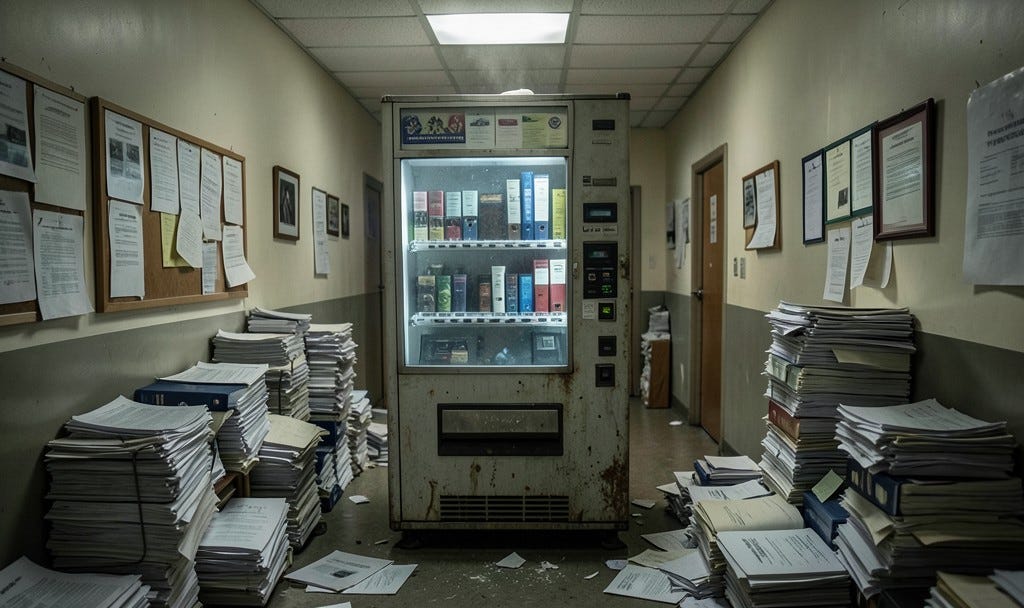
Mechanically very few systems survive nearly a century and a half while simultaneously convincing every generation that reform is imminent. That requires engineering. The legislation has become the legislative equivalent of an old time vending machine at a hockey rink.
Everybody complains about it. Nobody unplugs it. No one can locate the original owner’s manual. Yet somehow it survives every season and quietly sits humming in the corner, feeding the people.
What replaces the Indian Act?
Nothing.
Nothing replaces it.
The Indian Act is the thing preventing replacement. Which raises an awkward possibility. An entire policy industry may have spent decades searching for a replacement while standing inside the mechanism that made replacement impossible. It’s the Canadian version of a Gordian Knot tying the people to a mystery without a clue.