

Canada’s fire services are confronting unprecedented pressures. Wildfire seasons are growing longer, drought conditions are becoming more severe, and communities across the country are struggling to recruit and retain volunteer firefighters.
For Ernie Polsom, Chief Executive Officer of FireWise Consulting and a fire service professional with four decades of experience, these challenges are no longer predictions about the future. They are realities reshaping emergency response today.
“We have worked across Canada, and with First Nations, including the Kahnawake Mohawk Nation, which reflects our national footprint,” says Polsom. “We connect fire departments and their communities to advanced knowledge internationally and across the country.”
FireWise Consulting operates throughout Canada, including Newfoundland and Labrador, New Brunswick, Nova Scotia, Alberta, Saskatchewan, British Columbia and the Yukon. The company also provides consulting and educational services internationally, helping firefighters, investigators, inspectors and emergency managers adapt to evolving threats.
While firefighting remains at the centre of public attention, Polsom says prevention remains the most effective strategy.
“The most effective fire prevention is avoiding fires altogether.”
To that end, FireWise has expanded its focus beyond fire professionals to include building owners, managers and community leaders.
“Our Fire Inspection for the Building Owner course offers vital information that will help reduce fire risks and involve building owners as allies in the fire safety system.”
The training landscape itself has changed dramatically over the past two decades.
FireWise delivers a range of educational programs for investigators, inspectors and emergency personnel, including online certification training that allows students to complete nationally recognized qualifications from their home communities or fire stations.
At the same time, the nature of emergencies facing firefighters continues to evolve.
“While we are a full-service fire and emergency management consulting company, our training focus has traditionally been preventing or investigating structural fires,” says Polsom. “Our focus is expanding to include emergency management, leadership, and specialty investigations for emerging issues like electric vehicles or those with alternate fuels (LNG).”
Modern fire behaviour presents challenges that would have been difficult to imagine a generation ago. Advances in consumer technology, lithium-ion battery systems, synthetic furnishings and increasingly complex electrical systems have fundamentally altered the dynamics of structural fires.
According to Polsom, today’s firefighters face faster-moving fires, unpredictable fuel sources and hazards that require increasingly specialized knowledge and training.
Yet perhaps the greatest challenge facing fire services has little to do with equipment, hazards or technology.
“The shortage of volunteer firefighters is a big problem,” says Polsom. “Training demands are increasing while volunteer numbers are declining.”
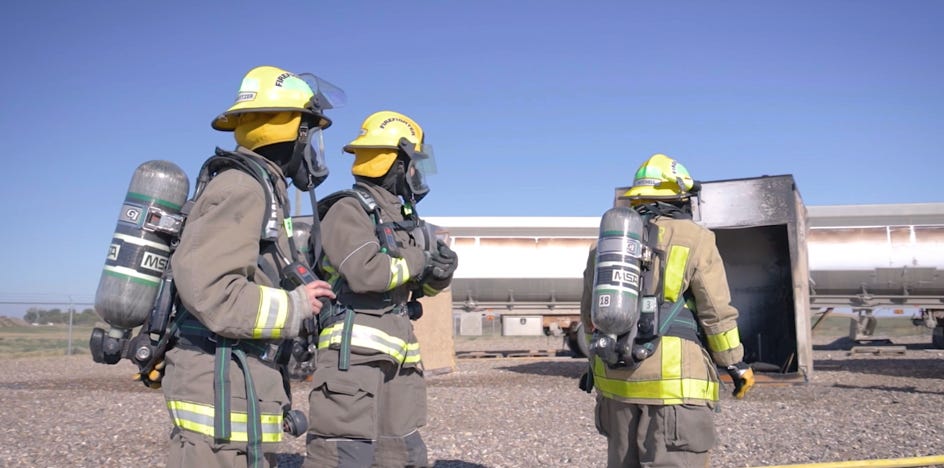
The issue extends well beyond Canada.
“We recently examined fire service optimization in Armenia,” he says. “The challenge was the same. There simply were not enough personnel. It is happening everywhere you look.”
The consequences are significant.
Volunteer departments form the backbone of emergency response in many rural and remote communities. In countless municipalities, volunteer firefighters respond not only to fires but also to vehicle accidents, medical emergencies, flood events, hazardous-material incidents and natural disasters.
When volunteer recruitment declines, community resilience weakens with it.
Recent studies by the Canadian Association of Fire Chiefs suggest Canada lost approximately 30,000 volunteer firefighters between 2016 and 2022, a trend that continues to concern fire service leaders nationwide.
At the same time, departments are being asked to do more than ever before.
“Twenty years ago, few volunteer departments handled much medical response,” says Polsom. “Now some departments are seeing medical calls account for up to seventy percent of their call volumes.”
The expansion of duties places additional pressures on both volunteers and career personnel already facing increased training requirements and operational demands.
Climate change has further complicated the picture.
According to Polsom, the effects are now visible in nearly every aspect of fire service operations.
“Climate change is affecting every aspect of our service model. From heat emergencies affecting residents with complex health requirements to the impacts of extreme heat on firefighters themselves, and the completely changed wildland-interface fire risk profiles confronting communities across Canada.”
The evidence is increasingly difficult to ignore.
“We see increased frequency and severity of drought cycles, extreme heat and lower snow levels,” he says. “These ongoing changes place First Nations and Métis communities on the front lines.”
Across Canada, communities that once considered large wildfires to be exceptional events are now preparing for them as recurring seasonal threats.
Major fires in British Columbia, Alberta, the Northwest Territories and other jurisdictions have demonstrated the national scope of the challenge. The consequences extend far beyond the initial burn zones.
“The loss of ground cover and forests makes our lands vulnerable to erosion and flash flooding,” says Polsom.
FireWise has witnessed these realities firsthand through investigations and consulting assignments.
In Hay River, Northwest Territories, the company was retained following devastating wildfire events to investigate fire origins and evaluate lessons learned from the response.
For Polsom, modern fire protection increasingly requires a broader approach than simply responding when disaster strikes.
“Every project we are involved in today focuses on climate change and sustainable resourcing in addition to the traditional areas of fire response and training.”
That philosophy has become especially important for Indigenous communities that often find themselves on the front lines of wildfire emergencies.
“First Nations across Canada are often on the front line of these fires,” he says. “There are ways to be prepared. We offer training programs that help communities protect homes, infrastructure and critical assets.”
Preparation, education and prevention remain the foundation of long-term resilience.

Whether through online certification programs, community planning initiatives, fire investigations or emergency management consulting, Polsom believes the goal remains the same: helping communities adapt to a new era of public-safety challenges.
The pressures facing Canadian fire services are unlikely to diminish in the years ahead. Climate change, evolving technologies and declining volunteer participation appear poised to remain defining issues for emergency responders across the country.
Yet Polsom remains optimistic.
“Together, we can help communities become more resilient and better able to protect themselves. Together, we can encourage the investments needed to strengthen public safety.”
In an era of growing uncertainty, that resilience may prove to be one of Canada’s most valuable emergency resources.

Article by Mack McColl for BLOWBACK Public Safety